Commercial Hot Water System
The global demand for the Commercial Hot Water System continues to expand as industries, public facilities, and commercial complexes prioritize stable, energy-efficient hot water supply. Rising energy costs, stricter environmental regulations, and the need for uninterrupted thermal output are accelerating adoption across diverse regions. With applications ranging from hotels and hospitals to manufacturing plants and food-processing facilities, the Commercial Hot Water System has become an essential infrastructure component in modern building and industrial engineering.
According to industry data, the market size for commercial hot water solutions has grown steadily, supported by infrastructure investments in Asia-Pacific, Europe, and the Middle East. Urbanization, commercial construction growth, and the rising demand for decentralized heat-generation technologies are major factors shaping market expansion. As a result, the Commercial Hot Water System occupies a strategic role in both new construction projects and retrofitting initiatives worldwide.
Global Market Overview for the Commercial Hot Water System
The global demand for the Commercial Hot Water System continues to expand as industries, public facilities, and commercial complexes prioritize stable, energy-efficient hot water supply. Rising energy costs, stricter environmental regulations, and the need for uninterrupted thermal output are accelerating adoption across diverse regions. With applications ranging from hotels and hospitals to manufacturing plants and food-processing facilities, the Commercial Hot Water System has become an essential infrastructure component in modern building and industrial engineering.
According to industry data, the market size for commercial hot water solutions has grown steadily, supported by infrastructure investments in Asia-Pacific, Europe, and the Middle East. Urbanization, commercial construction growth, and the rising demand for decentralized heat-generation technologies are major factors shaping market expansion. As a result, the Commercial Hot Water System occupies a strategic role in both new construction projects and retrofitting initiatives worldwide.
Key Global Trends and Market Drivers
The Commercial Hot Water System market is shaped by evolving energy policies, technology innovations, and shifting industry priorities. Current trends influencing adoption include:
• Transition toward high-efficiency heat pump water heaters and hybrid heating models.
• Integration of IoT-enabled monitoring for temperature control and energy optimization.
• Increasing adoption of renewable-assisted systems, such as solar thermal preheating.
• Expansion of commercial buildings requiring consistent hot water output for daily operations.
• Rising preference for systems with longer service life and reduced operational expenses.
These combined trends emphasize reliability, sustainability, and cost control—key drivers for selecting a Commercial Hot Water System in modern B2B procurement.
Technical Specifications of a Standard Commercial Hot Water System
A Commercial Hot Water System is engineered for high-volume, continuous output. While specifications vary across market segments, typical systems include:
• Heating Capacity: 20 kW to 300+ kW depending on application size
• Water Temperature Range: 45°C–85°C adjustable
• Energy Source Options: electricity, heat pump, gas, or hybrid configurations
• System Efficiency: 90%–300% depending on heat pump integration
• Storage Tank Volume: 300–10,000 liters
• Circulation Type: Direct, indirect, or closed-loop recirculation
Many solutions incorporate auxiliary heating elements, smart controllers, corrosion-resistant tank linings, and multi-stage heat exchangers to ensure stable performance.
System Structure and Engineering Design
The Commercial Hot Water System consists of several core components working together to deliver consistent thermal output:
• High-durability water storage tank with thermal insulation
• Heat exchanger (stainless steel, copper, or titanium for specific industries)
• Heating modules (heat pump compressor, electric coil, or gas burner)
• Intelligent controller for scheduling, temperature regulation, and energy monitoring
• Circulation pump and safety valves for pressure management
• Anti-corrosion coating or enamel liner to extend tank life
These components are engineered to withstand prolonged operational cycles typical in commercial environments where daily hot water demand remains high.
Manufacturing Process and Quality Assurance
The production of a Commercial Hot Water System involves precise engineering and extensive quality control measures:
1. Selection and testing of heating components, compressors, exchangers, and insulation materials.
2. Automated welding and sealing of tank structures to ensure long-term pressure resistance.
3. Application of protective coatings or liners to prevent corrosion and scaling.
4. Assembly of electrical components and safety devices under international standards.
5. Performance testing including thermal efficiency verification, leakage testing, and endurance trials.
6. Compliance checks with international certifications for mechanical and electrical systems.
The rigorous manufacturing process ensures that each Commercial Hot Water System meets demanding operational requirements across global commercial sectors.
Application Scenarios Across Commercial and Industrial Sectors
A Commercial Hot Water System is essential across a wide range of facilities where high-volume hot water output is critical:
• Hotels and resorts requiring 24/7 water heating for guest services
• Hospitals and clinics with stringent hygiene and temperature needs
• Food and beverage factories utilizing hot water for sanitation and processing
• Laundries and textile units demanding continuous heated water supply
• Schools, gyms, and sports centers for showers and cleaning systems
• High-rise commercial buildings and apartment complexes
Its scalability and compatibility with different heating sources make it suitable for both centralized and distributed hot water networks.
International Buyer Preferences and Procurement Challenges
For global B2B buyers, selecting the right Commercial Hot Water System requires detailed evaluation of several factors. Buyers typically prioritize:
• Verified energy efficiency data and long-term operational cost projections
• High-grade materials with proven corrosion resistance
• Compatibility with regional plumbing, electrical, and building codes
• Availability of multi-capacity models for different project scales
• Smart control capabilities for monitoring and energy savings
• Clear documentation, installation instructions, and after-sales support
Frequent challenges include unclear performance data, non-standardized specifications, insufficient installation guidance, and unreliable warranty support. To help buyers overcome these barriers, We provide complete technical documentation, performance reports, and system selection guidance suitable for commercial engineering teams.
Conclusion
The Commercial Hot Water System remains an essential infrastructure for global commercial and industrial operations. Its growing demand is driven by rising energy efficiency standards, the need for reliable hot water supply, and ongoing commercial construction worldwide. With proper engineering, high-grade materials, and certified performance, the system delivers long-term value and operational stability. Global buyers seeking tailored solutions can request comprehensive technical details and project-based configuration support.
FAQs
1. What capacity range is suitable for a commercial project?
Capacity depends on daily hot water demand. Systems typically range from 20 kW to over 300 kW, with storage tanks sized between 300 and 10,000 liters.
2. Can a Commercial Hot Water System integrate with renewable energy?
Yes. Many commercial systems support solar thermal preheating or hybrid configurations using heat pumps to maximize efficiency.
3. What certifications are important for commercial installations?
Buyers generally look for compliance with international mechanical, electrical, and pressure-vessel standards depending on the region.
4. How can buyers request technical documents, CAD drawings, or quotations?
Buyers may contact our engineering team to receive system specifications, detailed technical sheets, sample availability, and customized quotations tailored to their project.
For complete engineering guidance, pricing details, or customized system recommendations, We welcome global buyers to request full documentation and system samples.
You have not enough Humanizer words left. Upgrade your Surfer plan.
Applicable Scene:
Flat plate solar water systems are used for water heating in homes, schools, hotels, factories and industries.
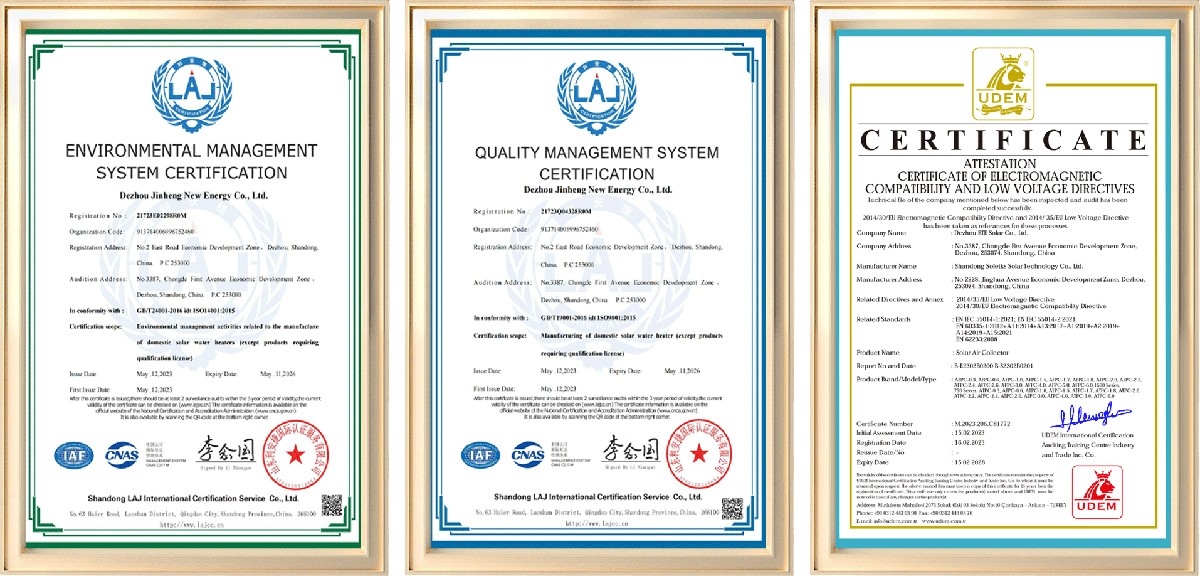
Honors and Qualifications: