Español
 Francés
 Português
 Italiano
 Türk
Türk
 العربية
 Русский
 한국어
한국어
 日本語
日本語

In-depth Analysis: Why Solar Energy and Air Energy Have Become the "Golden Combination" for Efficient Heating
Introduction
Under the backdrop of the "dual carbon" goals and the transformation of the energy structure, the heating industry is undergoing a fundamental iteration from traditional fossil energy to clean energy. The safety hazards of gas heating, the geographical restrictions of centralized heating, the high energy consumption of pure electric heating, and the intermittency of pure solar heating have left countless users in a dilemma of choice. The combined heating solution dominated by solar energy and supplemented by air energy, relying on the core advantage of solar energy being a "free energy source" and the supplementary function of air energy, achieves "main and auxiliary coordination and efficiency doubling", gradually standing out among numerous solutions and becoming a "golden combination" that takes into account energy conservation, stability, economy and environmental protection. As a technology-oriented group enterprise with a complete industrial chain of comprehensive solar energy utilization solutions, Shengtuoke Group ranks second in the world in terms of flat-plate solar collector production. With a full industrial chain layout from core materials to solutions, it maximizes the energy value of solar energy and maximizes the release of the practical value of this "optimal solution". This article will deeply dissect the core and leading role of solar energy in heating solutions from multiple dimensions such as technical logic, core advantages, and practical applications.
The underlying logic of technology
Solar energy takes the lead, with air energy making up for it
1. Solar heating: The "Energy Core" and "Free Engine" of the Heating System
Solar heating is the absolute core of the entire system. Its core principle is to maximize the absorption of solar radiation energy through high-efficiency solar collectors (such as Shengtuoke EFPC large flat plate collectors), convert it into thermal energy to heat the medium (water or antifreeze), and then transport it to the indoor heat dissipation terminal (floor heating, radiator) through the heating network. As a core representative of renewable energy, solar energy has the natural advantages of "zero operating costs, zero carbon emissions, and unlimited supply" - as long as there is sunlight, it can continuously generate free heat, and it is clean, pollution-free, and noise-free, making it the "ideal choice" for clean heating.
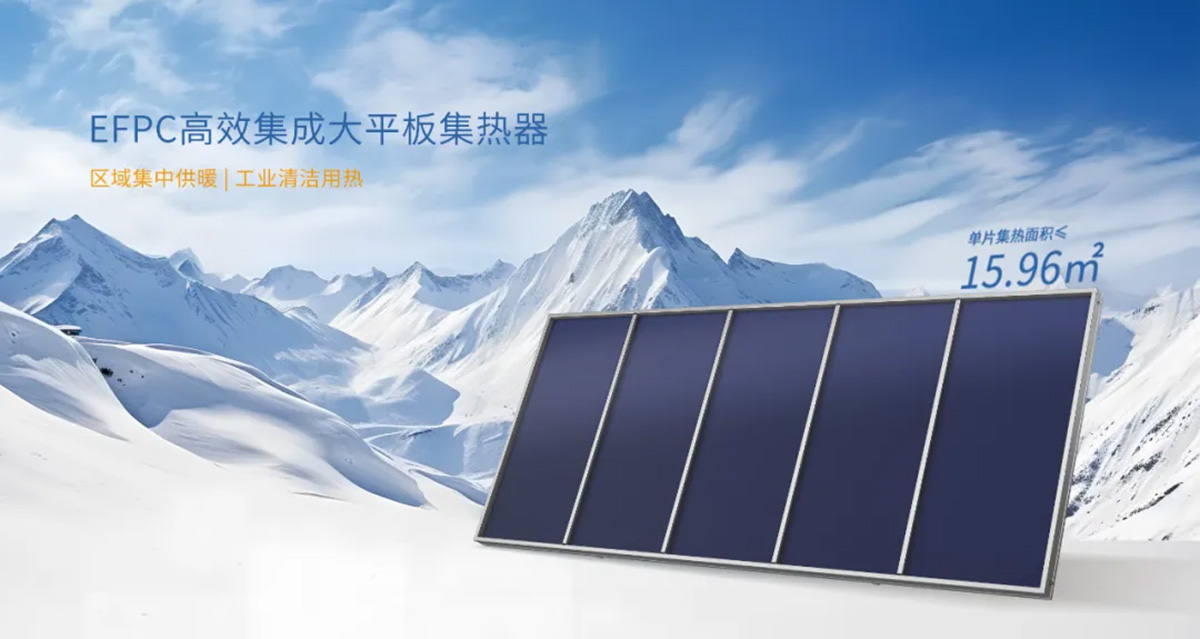
In practical applications, the energy contribution of solar energy accounts for as high as 60% to 70%, making it the "main force" in meeting daily heating demands: on sunny days in northern winters, solar collectors can continuously generate heat for 8 to 10 hours during the day, fully covering the heating needs during the day. In regions with better sunlight conditions in the south, solar energy can even meet over 80% of the heating load, truly achieving a low-cost model of "heating while basking in the sun". Shengtuoke's high-efficiency flat-plate collectors, with their advanced core materials and processes, can maintain high heat collection efficiency even in complex environments such as weak winter light and smoggy days, further expanding the application scenarios of solar energy.
2. Air energy: An "auxiliary backup tool" for solar energy, only used as an emergency fallback
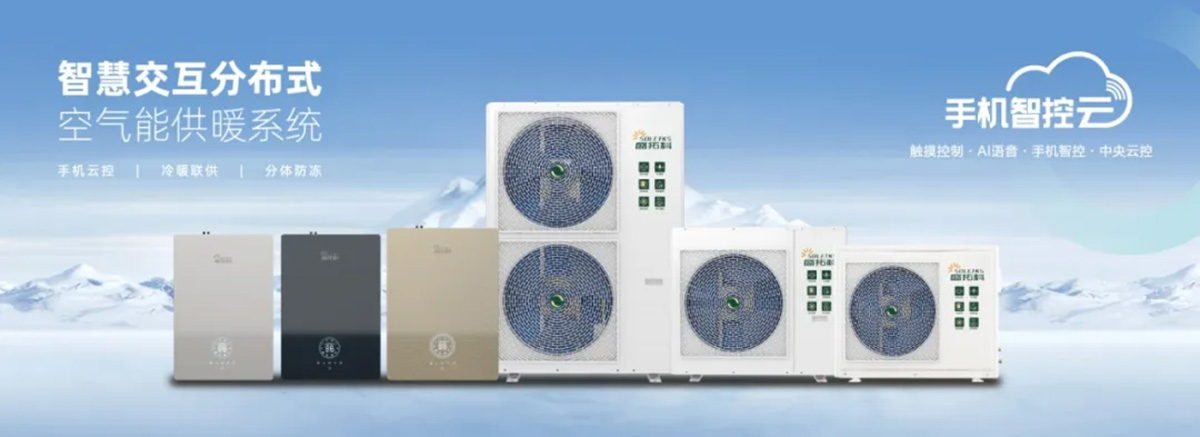
Air energy heating (air source heat pump) only plays a "supplementary" role in the system. Its core function is to provide temporary supplementary heat in extreme scenarios where solar energy cannot generate heat (such as at night or during continuous rainy days), ensuring that heating is not interrupted. Its working principle is to consume a small amount of electrical energy to absorb the low-level heat energy in the air and convert it into high-level heat energy to assist in heating. Essentially, it is a supplementary means to provide a safety net for solar energy - there is no need to pursue ultimate energy efficiency; it only needs to meet the basic demand for "emergency supplementary heating".
3. Main and auxiliary synergy: Dual guarantee of "low cost + stable supply"
The core logic of the solar + air energy heating solution is to take solar energy as the absolute core and air energy as a supplement, achieving the dual goals of "low-cost operation" and "all-weather stability"
(1) When there is sufficient sunlight (sunny or cloudy days during the day) : Solar energy operates at full capacity, fully meeting or even exceeding the heating demand. Air energy is on standby, and the system operation cost approaches zero.
(2) When there is no light or insufficient light (at night, or during continuous rainy days) : Air energy will activate emergency heating to maintain the indoor temperature at a comfortable level. Once the light is restored, it will immediately switch back to the solar-dominated mode to minimize the operating cost again.
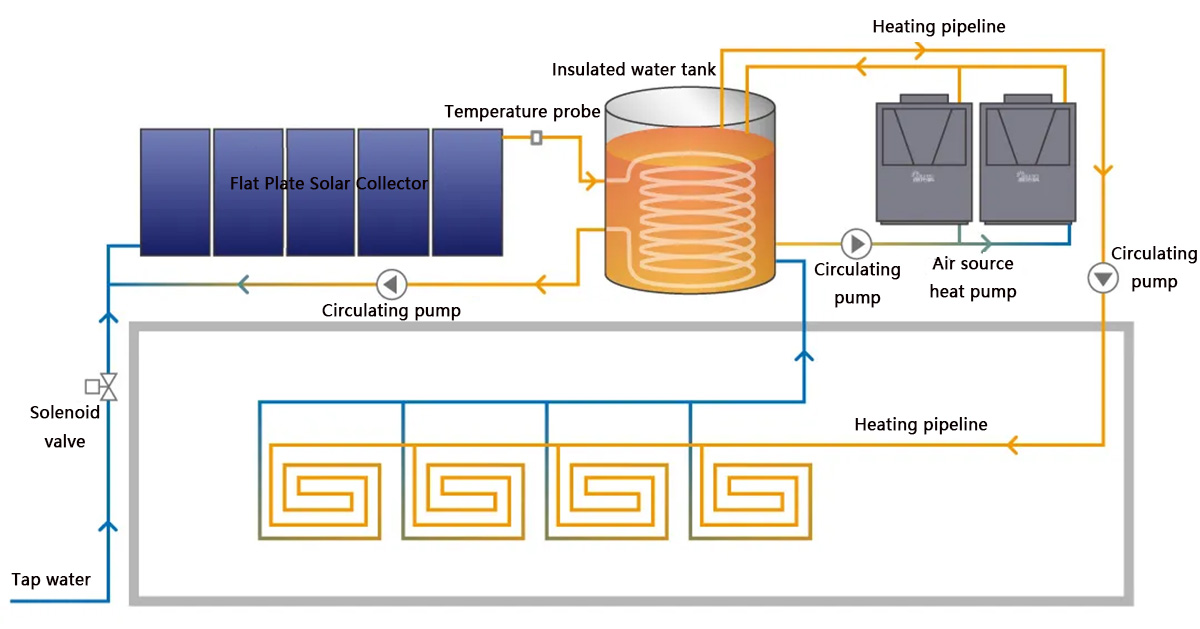
Under this model, solar energy has completely addressed the core pain point of "high operating costs for heating", while air energy merely serves as an "infrequently used supplementary tool", breaking through the intermittent shortcomings of pure solar energy. It not only retains the core advantages of solar energy, such as "zero cost and zero emissions", but also does not require the configuration of large-capacity hot water storage tanks (conventional heat storage can meet transitional demands), significantly reducing initial investment Achieve an efficient combination of "clean heating".
Core advantage
Four major dimensions outshine traditional heating solutions
1. Energy efficiency: Solar energy contributes over 60% to 70% of the heat, reducing operating costs by 70% directly
Compared with the operating costs of mainstream heating solutions (taking a 100-square-meter residence as an example, with a winter heating period of 120 days and an indoor temperature maintained at 20℃) :
(1) Pure electric heating: The total cost is approximately 8,000 yuan;
(2) Gas heating: The total cost is approximately 6,000 yuan;
(3) Pure air source heat pump heating: The total cost is approximately 2,400 yuan.
(4) Solar energy + air energy heating: Solar energy contributes 60% to 70% of the core heat, while air energy only supplements 30% to 40% of the emergency heat. The total cost is only 800 to 950 yuan, which is over 85% lower than pure electric heating, over 80% lower than gas heating, and over 60% lower than pure air energy.
The core energy-saving advantage stems from the free supply of solar energy: As long as there is sunlight, the system does not need to consume paid energy sources such as gas and electricity. Over the long term, the higher the proportion of free heat from solar energy, the more users can save. In northern regions with abundant sunlight, solar energy can contribute over 70% of the heat in winter, and some families can even achieve "zero electricity and zero gas fees" during the heating season.
2. Stability: Solar energy + air energy, all-weather operation
The stability shortcoming of traditional heating solutions essentially lies in "relying on a single supply of paid energy". The solar-led combination solution, with the dual guarantee of "free energy as the main and supplementary energy as the auxiliary", achieves stable heating in all scenarios.
3. Adaptability: Solar energy can be flexibly installed and cover all heating scenarios
The installation flexibility of solar collectors determines the extremely strong adaptability of the entire solution, almost covering all building types and climate zones:
(1) Decentralized scenarios: For buildings without centralized heating such as self-built houses in rural areas, villas, and suburban townhouses, solar collectors can be directly installed (on rooftops or balconies), and small air energy sources can be used to fill the gaps, without relying on any pipeline networks.
(2) Home heating/hot water scenarios: Compatible with all house sizes, achieving "on-demand configuration" : Small-sized houses can choose small flat-plate collectors, which are easy to install and do not take up too much space. Large-sized apartments can be equipped with multiple collectors to form an array, which can be connected in series through pipelines to achieve sufficient heat production, meeting the dual demands of whole-house heating and domestic hot water. The air source heat pump outdoor unit is only used as an auxiliary accessory. It is small in size and can be placed in an outdoor corner without affecting the indoor space layout.
(3) Commercial heating/hot water scenarios: Perfectly suitable for centralized energy consumption scenarios such as hotels, guesthouses, hospitals, schools, swimming pools, and nursing homes. Such places have a large demand for hot water and fixed heating times. Solar collectors can be laid on a large scale on rooftops or open Spaces, storing heat through centralized heat storage systems to meet the needs of centralized heating and hot water supply during the day, significantly reducing energy costs in commercial operations.
(4) Industrial heating scenarios: Suitable for scenarios such as food processing, textile printing and dyeing, chemical engineering, and pharmaceuticals that require medium and low-temperature industrial heating. Solar collectors can be customized to design heat collection systems based on the scale of industrial heat demand, directly providing hot water or auxiliary heating for production processes, replacing traditional coal-fired and gas-fired boilers. This not only reduces the energy expenditure of industrial enterprises but also cuts down on carbon and pollutant emissions, facilitating the realization of the "dual carbon" goals in the industrial sector. At the same time, it avoids the cost risks brought about by fluctuations in fossil energy prices.
(5) Clean energy consumption scenarios for agricultural planting and breeding: Suitable for greenhouses, seedling bases, livestock and poultry breeding, etc., which require a constant temperature environment, promoting the development of green agriculture.
(6) Climate adaptation: In the severely cold northern regions, the low-light heat collection capacity of Shengtuoke's high-efficiency collectors is relied upon. In the humid southern regions, most of the heating demands can be met through solar energy, while air energy is only occasionally activated during the rainy season.
The core of this wide adaptability lies in the "modular design" and "flexible installation" features of solar collectors. Air energy only serves as an "auxiliary accessory" and does not affect the overall adaptability of the solution.
4. Environmental friendliness: Solar energy has zero emissions, contributing to the realization of the "dual carbon" goals
Under the "dual carbon" goals, the environmental advantages of solar energy have become the core competitiveness:
1. Solar energy has completely zero carbon emissions and zero pollutant emissions, making it a truly clean heating energy source.
2. Although air energy consumes a small amount of electricity, it only operates during emergency heating, with extremely low total energy consumption. Moreover, the electricity can come from renewable energy sources such as wind power and photovoltaic power, and its overall carbon emissions are only one-tenth of those of gas heating.
3. The entire system has no safety hazards such as gas leakage or carbon monoxide poisoning. The solar collector is completely noise-free, and the operating noise of the air source heat pump outdoor unit is only 40 to 50 decibels, which does not affect the living environment.
The zero-emission feature of solar energy makes this solution a core driving force for the "dual carbon" goals.
Core of the plan
A multiple balance dominated by solar energy
The reason why the solar energy + air energy heating solution is highly efficient is essentially that the core advantages of solar energy have achieved multiple balances: Solar energy has addressed the core pain points of "high operating costs" and "severe pollution", while air energy, merely as a "supplementary tool", has broken through the intermittent shortcoming. Ultimately, it has achieved a perfect balance between "zero cost and stable supply", "environmental protection and practicality", and "wide adaptability and low-cost operation".
This solution is neither like pure solar energy which is "dependent on the weather", nor like pure air energy and gas heating which are "dependent on paid energy", nor like pure electric heating which is "highly energy-consuming". Under the major trend of energy transformation, the core and dominant position of solar energy is becoming increasingly prominent. The value of Shengtuoke lies in maximizing the advantages of free, clean and unlimited supply of solar energy through high-efficiency solar collectors and a full industrial chain layout, making "sunbathing for heating" the mainstream and promoting the heating industry into a clean heating era dominated by solar energy.