

 Español
 Francés
 Português
 Italiano
 Türk
Türk
 العربية
 Русский
 한국어
한국어
 日本語
日本語

Heat Pipe Split Solar Water Heater System: A New Breakthrough In Modern Hot Water Heating
The Next Innovation In Solar Thermal Utilization
Against the backdrop of the "dual carbon goals" and the global energy transition, clean energy has become the top priority in the energy strategies of all countries. Solar energy, as one of the most abundant and cleanest forms of energy, is gradually replacing traditional fossil fuels in the fields of hot water and heating. Among the various types of solar water heaters, the heat pipe split solar water heater system is becoming the focus of global market attention due to its high efficiency, cold resistance and relatively low maintenance cost.
Traditional flat-plate solar water heaters have been in use for decades, but their performance is often limited in cold regions or areas with large temperature differences. In contrast, the heat pipe split system, with its unique structure and heat transfer method, not only can operate stably in extreme climates but also effectively solve the long-standing pain points that have troubled users during the usage process.
What is a heat pipe split solar water heater system?
In simple terms, this is a solar water heating system that combines vacuum tubes with heat pipe heat transfer technology. It usually consists of two main parts:
1. Vacuum tube collector (with heat pipe)
Each vacuum tube is equipped with a sealed copper heat pipe inside, in which a small amount of volatile working medium is pre-filled.
Under the effect of solar radiation, the working medium at the bottom of the heat pipe vaporizes rapidly, and the steam rises to the condensation end.
At the condensing end, the steam releases heat to the water or antifreeze in the circulating pipe, which then condenses back into liquid and flows back.
2. Split-type water storage tank
The water storage tank and the collector are installed separately and are usually placed indoors or on the ground, avoiding the influence of direct sunlight and climate changes.
The split design not only facilitates installation but also effectively extends the lifespan of the water storage tank and enhances the reliability of the entire system.
Unlike the traditional direct heating system, the heat pipe split system adopts indirect heat transfer, that is, water does not directly enter the vacuum tubes but completes heat transfer through the heat exchanger. This approach fundamentally resolves long-standing problems such as scale formation, cracking due to freezing, and corrosion.
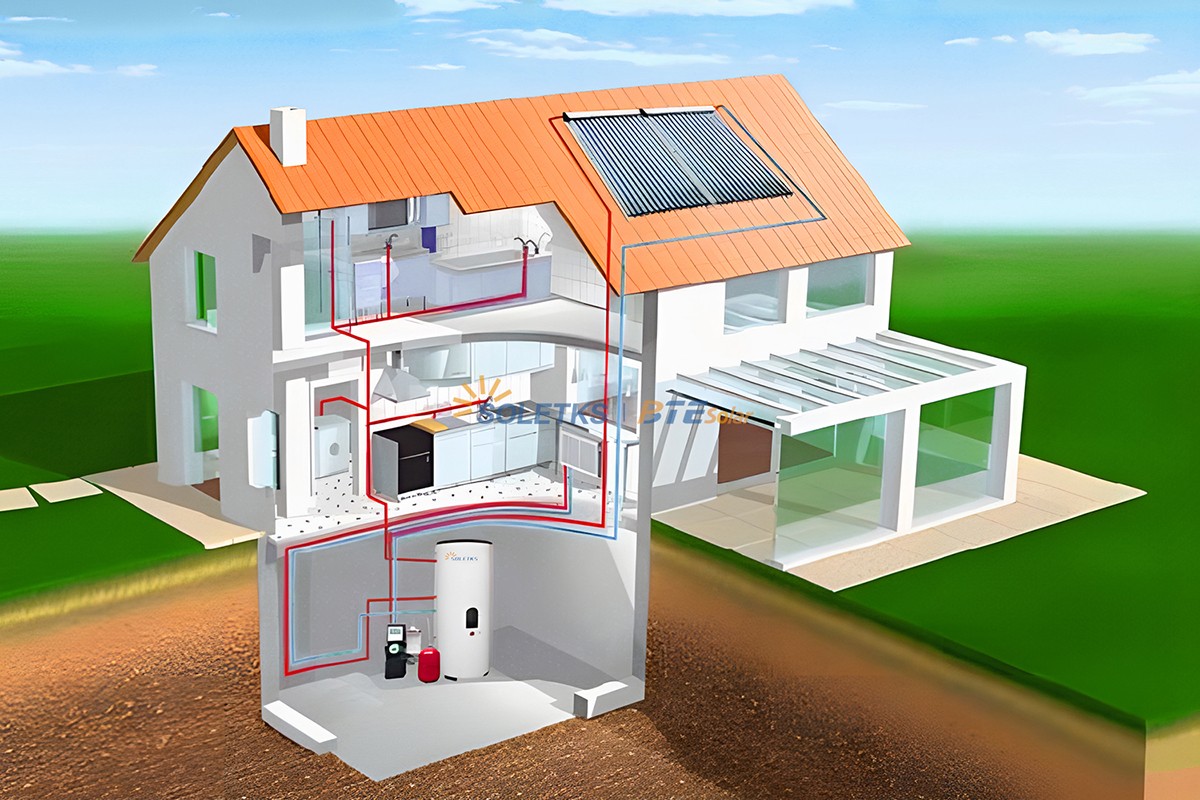
Technical principle analysis: The high efficiency of phase change heat transfer
The working principle of heat pipes is based on "phase change heat transfer". The process can be divided into four stages:
1. Evaporation: Solar radiation causes the working medium at the bottom to vaporize rapidly.
2. Transmission: Steam carries latent heat and rises rapidly with almost no energy loss.
3. Condensation: Heat is released at the condensation end to feed water or antifreeze, and steam turns into liquid.
4. Reflux: Under the effect of gravity, the liquid returns to the bottom and evaporates again.
Because the heat transfer speed of heat pipes is dozens of times faster than that of solid metals, they can maintain a high thermal efficiency even under low-temperature or low-light conditions.
The pain points and shortcomings of traditional solar water heaters
Many users encounter similar problems when using traditional solar water heaters:
1. It is prone to freezing in winter
In flat plate or direct heating systems, water flows directly through the collector, and the pipelines are prone to cracking due to freezing in sub-zero temperatures.
2. The problem of scale is serious
After long-term use in hard water areas, the pipelines and heat exchangers are severely scaled, resulting in reduced efficiency and frequent cleaning.
3. Large energy loss
The insulation of ordinary systems is poor. The hot water heated during the day often drops significantly in temperature at night.
4. High maintenance cost
Users need to regularly remove scale and replenish antifreeze, which increases hidden costs.
These pain points not only affect the user experience but also limit the global popularization of solar water heaters.
The advantages of the split heat pipe system
1. Adapt to cold climates
As water does not directly enter the vacuum tubes, the system has almost no risk of freezing and cracking and can operate stably in an environment of -30℃.
2. High heat transfer efficiency
The heat pipe has a fast heat transfer speed, which makes the water temperature rise rapidly and the hot water supply more stable.
3. Long service life
Vacuum tubes have excellent heat preservation performance, strong impact resistance, and a normal service life of up to 15 to 20 years.
4. Low maintenance required
There is no need to frequently clean scale or add antifreeze, making operation more worry-free.
5. Strong scalability
Users can flexibly increase the number of vacuum tubes or replace the water storage tank with a larger capacity according to their family or business needs.
Application scenarios and cases
1. Northern resident families
In regions with extremely cold winters such as Heilongjiang and Inner Mongolia, after households adopt the heat pipe split system, they can ensure a continuous supply of hot water even when the outdoor temperature drops to -25℃.
2. European hotels and resorts
Some resort hotels in Austria and Switzerland have utilized this system to meet the demand for centralized hot water, achieving an energy-saving rate of over 60% and simultaneously establishing the brand of "green hotels".
3. South American industrial enterprises
Some food processing plants in Chile use heat pipe systems to preheat production water, saving hundreds of thousands of dollars in natural gas costs every year.
4. Public facilities in Africa
Some hospitals and schools in South Africa have installed large heat pipe split systems with the support of aid projects, which not only reduce energy costs but also improve the medical and educational environment.
Expert Opinion
Energy systems engineering, pointed out:
The heat pipe split system is a particularly competitive solution in cold regions. Its phase change heat transfer technology has enabled solar water heating applications to break through geographical and climatic limitations, and its market share in the global market will continue to rise in the future.
Market trends and policy support
According to data from the International Renewable Energy Agency (IRENA), the average annual growth rate of global heat pipe split solar water heaters has remained above 12% since 2020.
1. In the Asia-Pacific region, China is the largest producer and consumer, with its vacuum tube output accounting for over 70% of the global total.
2. Europe: Germany, Austria and Nordic countries are accelerating promotion, especially in cold regions.
3. Africa: International aid promotes the installation of schools and hospitals, with huge market potential.
Meanwhile, an increasing number of countries have introduced fiscal subsidies, green credit, and building energy efficiency standards to promote the popularization of solar thermal utilization.

Challenges and improvement directions
1. The price is relatively high: The initial investment is 15% to 30% higher than that of ordinary tablet systems.
2. Installation and transportation risks: Vacuum tubes are prone to damage during transportation and require higher packaging and installation standards.
3. Overheating risk: In hot regions, if no one uses hot water, the system may stall.
At present, manufacturers are addressing these issues by strengthening the glass material of vacuum tubes, improving automatic temperature control valves, and adding intelligent monitoring systems.
Case study
1. In the Ontario community of Canada, after the unified installation of the heat pipe split system, the average hot water cost for resident households has decreased by 65%.
2. Johannesburg Hospital in South Africa: Installation of an 8,000-liter system to replace diesel boilers saves $20,000 annually, with a payback period of four years.
3. The University of Melbourne in Australia: The dormitory adopts a heat pipe system, which not only saves energy but also serves as a teaching case for renewable energy.
Future Outlook
With the development of nano-coated vacuum tubes, intelligent Internet of Things monitoring, and air-source heat pump hybrid systems, the performance of the heat pipe split system will be further enhanced.
Experts predict that by 2035, the market share of this system in the cold climate market may reach 40%, making it one of the mainstream technologies for global solar water heaters.
Conclusion
The heat pipe split-type solar water heater, with its unique heat transfer technology and split design, has successfully addressed the shortcomings of traditional systems in cold climates, providing users with an efficient, reliable and low-maintenance clean energy solution.
In the global tide of energy transition, it can not only reduce energy costs for households and business institutions, but also significantly cut carbon emissions. It can be foreseen that with technological progress and market promotion, the heat pipe split system will become an important part of the future green life and low-carbon society.
1. Rich cases: rich production, installation, and application case guidance.
2. Personalized production: products can be customized and personalized according to customer needs.
Scope of application
Distributed household heating/district heating/heat for industrial and agricultural processes.


